


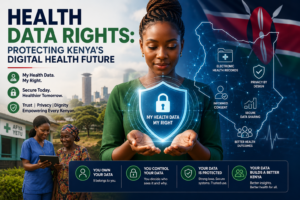
The rapid expansion of digital health systems presents significant opportunities to improve healthcare delivery, strengthen disease surveillance, enhance service efficiency, and support the realization of Universal Health Coverage (UHC). Across Kenya and globally, governments and institutions are increasingly embracing digital technologies to modernize health systems and improve health outcomes. However, as digital health systems continue to evolve, equally important questions emerge around the protection of personal health information, informed consent, accountability, and the rights of individuals within these systems.
The future of healthcare cannot be built on technology alone; it must also be grounded in trust, transparency, and respect for human rights. Health data is among the most sensitive forms of personal information. It contains deeply private details about individuals’ physical, mental, and social wellbeing, and if mishandled, can expose people to discrimination, stigma, exploitation, and other forms of harm. Despite the increasing digitization of healthcare services, many individuals still lack sufficient awareness of how their data is collected, stored, shared, or used. Others are often excluded from conversations and decisions regarding digital health governance, even though they remain directly affected by these systems. This gap between technological advancement and public understanding continues to present significant ethical and governance challenges.
Kenya has made important progress in establishing legal and policy frameworks intended to strengthen digital health governance and data protection. The Digital Health Act, 2023 and the Data Protection Act, 2019 provide a foundation for safeguarding personal information, regulating the processing of health data, and promoting accountability among institutions handling sensitive data. These frameworks recognize the importance of privacy, confidentiality, informed consent, and responsible data management. However, laws and policies alone are not enough. Effective implementation, public awareness, institutional accountability, and continuous oversight remain essential in ensuring that these protections are meaningful in practice.
One of the most critical issues within digital health governance is informed consent. Individuals must have the right to understand why their data is being collected, how it will be used, who will access it, and what risks may be associated with sharing it. Consent should never be assumed or obtained through unclear or inaccessible processes. It must remain voluntary, informed, and revocable. People should also retain the right to withdraw consent without fear of discrimination or denial of essential services.
Protecting these rights is fundamental to preserving dignity and public trust within healthcare systems. Accountability mechanisms within digital health systems must be strengthened to address misuse, unauthorized access, and unethical handling of personal information. As healthcare systems become increasingly interconnected, the risks associated with data breaches, cyber threats, and exploitation of personal data also continue to grow. Institutions handling health data therefore carry a responsibility to establish strong safeguards, including secure digital infrastructure, transparent governance systems, ethical oversight, and clear procedures for addressing violations. Without accountability, public confidence in digital health systems will remain fragile.
Emerging technologies such as Artificial Intelligence (AI) are also reshaping the future of healthcare and data governance. AI systems have the potential to improve diagnostics, healthcare planning, disease surveillance, and service delivery. However, these technologies also introduce complex ethical and legal questions regarding automated decision-making, bias, transparency, ownership of data, and long-term storage of sensitive information. As Kenya advances toward more data-driven healthcare systems, it is important that innovation does not outpace regulation and ethical responsibility. Technological progress must remain people-centered and rights-based.
Civil society organizations, media actors, policymakers, healthcare providers, and communities all have a critical role to play in advancing health data rights in Kenya. Stronger collaboration, public education, policy advocacy, and multi-sectoral partnerships are necessary to build a digital health ecosystem that is transparent, ethical, and accountable. Public trust cannot be achieved through legislation alone; it must be earned through consistent protection of rights, meaningful engagement with communities, and demonstrated institutional integrity. The conversation on health data rights is therefore not only about technology or governance frameworks. It is ultimately about protecting human dignity, strengthening public trust, and ensuring that every individual remains at the center of digital health transformation.
As Kenya continues to embrace innovation within the health sector, there is an urgent need to ensure that digital progress is matched by equally strong commitments to privacy, equity, accountability, and justice. Through collective action, stronger partnerships, and sustained advocacy, we can help shape a digital health future where technology serves people responsibly, ethically, and inclusively. Protecting health data rights is not simply a legal obligation; it is a public responsibility and a necessary foundation for building resilient, people-centered health systems for present and future generations.
#MyDataOurHealthKe
References:
By: Joy Gacheri (Communication and Media Asst)